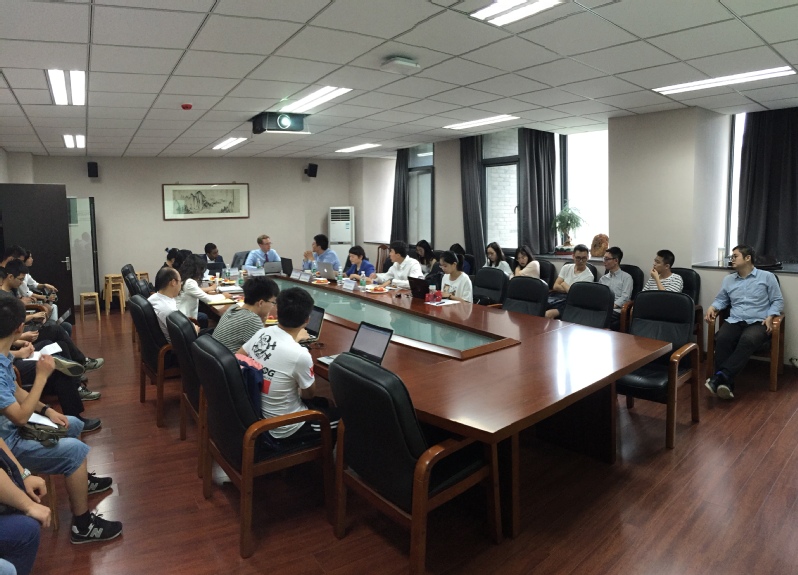
The seminar about Sino-U.S. relations was held by CAPDS of Nanjing University on June 21at Room 321 Shengda Building. Professor Qi from the School of Government presides it and a lot of scholars and students from Nanjing university and other universities attend it. We have two main speakers whose names are John Schaus and Dewardric Mcneal. Doctor Mao briefly introduces our CAPDS and this seminar and Professor Qi gives us a short introduction of these two main speakers and other scholars attending this seminar. And then we enjoy two attracting speeches.

U.S.-China Relations in 2015-A U.S. Vision of Security Cooperation
John Schaus
Thank your for invitation and welcoming. I am happy to be here. I have been to China many times, and I lived in Jilin for two years long ago. But this is my visit to Nanjing. I am looking for the exchanges with all of you. Besides, my presentation was designed to be an hour. I will brief some sections so that we can have better some discussion for that. Here is a brief agenda for my talk. I will give a brief introduction of who I am and my perspective, because in talking with any American , I think that is an important touchstone. Secondly, I will describe what cooperation is. Thirdly, I will lay out what the vision of 2025 I think it will be. Fourthly, I will talk about what are the elements to achieve that vision. Fifthly, we will focus on not just security cooperation in 2025, but also how does U.S.-China cooperation look and also conclusion thoughts.
Ⅰ . Introduction
My perspective: I grow up in Minnesota and went to college there. Then I spent two years living in Jilin. I taught English and studies Chinese there. I did my graduate work in public policy and international affairs in college in Minnesota. And when I finished, I went to Washington DC and begun work at CSIS where I am now. That was twelve years ago. As a result of where I am working and what I have done, I think I am largely an internationalist. So I assumed that engaging in other countries is good and part of my job is to find common ground with people whether they are Democrats or Republicans, Chinese or German or Japanese, whomever. Finding common grounds to achieve better policy positions a better outcome for that relationship. As a result I live in a very small circle of people professionally. It is usually a part of Washington establishment, a block or a swamp, depending on where you are in the political aspect. But I notice that not because that makes me particularly special, but because in many ways it makes me not be the representative of average Americans’ vote. Many Americans do not understand recent why we need to engage in a dialogue, they don’t understand what the opportunities and risks are, and they more focus on what happens at home, in their cities, in their counties or in their states than on what happened between Washington and Beijing, or other foreign capitals. That is the different perspective that many Americans want to share.
The third big point I want to say is I think U.S.-China relations has changed and those participating in it have changed. And I offer one specific antidote of that. So in 2005, I started to work at CSIS, and I worked directly for the president. John Henry who is a former senior defense department official begun to run CSIS in 2000. When I joined CSIS, the Washington policy community was roughly evenly divided between this who thought China as a great opportunity and that we need to engaged, and part of Washington thought that China was a threat that we need to prepare to counter. In 2011, I went to work with McNeal in Pentagon and I was there for four years. In 2014 when I came out, the political landscape and policy landscape in Washington has changed fundamentally. You know if there were a hundred Chinese analysts on the list, it would be fifty to fifty when I went to Pentagon, for good relations and for preparation for challenges. When I came out, it was night-eight to two. People who thought we need to prepare for the challenges from China has risen and stop thinking that as an opportunity. When I put that on the table at the beginning, because I think it is fundamentally shaping how Washington is dealing the relationship. And I will come back latter on what elements drive that and I think that is important. And I think it is important to know the values of these dialogues and we need to have more of them, So, before we get to the body part, there are some quick questions I would ask you to keep in mind:
1. What are the greatest security issues you see for China ?
2. What role do you think the United States should play in addressing those ?
3. What security role should U.S. play in OBOR ?
4. What benefit does China seek that the current system does not permit to achieve ?
Ⅱ . Security Cooperation
What do I mean when I use this term ? I am not telling you yet. First I am going to tell you what U.S Defense Department means when he says security cooperation. It is a very broad definition. All Department of Defense interactions with foreign defense establishments to build defense relationships that promote specific U.S. security interests, develop allied and friendly military capabilities for self-defense and multinational operations. That is security cooperation if you ask the Department of Defense. But I think that is two narrow, and in some way it is too broad for our conversation. For today’s discussion, we need a different definition. To me, security cooperation is U.S. cooperations with another country on security defense, or military issues with the objective of reducing a common threat or being better able to respond to contingencies in ways that promote-—rather than undermine—-security. You are welcome to disagree or have comments on this definition, but foe the rest of the speech, this is what I mean when I say security cooperation.
What is it for ? It is for building confidence in capabilities that when one country and another country can not bring to a given situation. That involves security broadly, which is often a civilian letter or diplomatic letter effort at the peak of a broad engagement or a defense military enforcement. But it is also confidence in capability to deliver what one says and what he is going to do, at the whole range of positions. And second is about developing patterns of cooperation. If you have to do something immediately, it is very hard to create the structures and communication to be effective when I am doing it, if you have thought about it and work on it in advance. And so for me, security cooperation is also about developing its pattern of cooperation. Whatever cooperation is leading to, whatever specific object of the cooperation, it is not doing once and going away. It is participating that and over time it is not just two military commanders or two ministers of defense but it will repeat number of them all have similar experience of what cooperation looks like.
What does that look like ? From a purely American perspective, let me give the three parts I have mentioned before: military cooperation, defense cooperation and security cooperation. At the military level, it is often about military exercise. So what is United States going to do with their allies or partners to be prepared to counter real threats. And I offer the exercises that the United States takes with South Korea, and with Japan and with Australia. To be ready to respond to allies, if we have to. But also including that I think is unaltered and unannounced depending on U.S. encountering that thing, CUES. It happens pretty often in military defense and it lowers the risk. What it looks like at the defense level? There are a lot of examples, the one I know best, because it happened the last time I was in China, is defense policy talks. These are senior defense officials, in United states they are civilians, in Chinese system they are senior PLA official. They have talks about what kind of policies our two defense establishment pursue and what objectives of those policies are, so that both sides can have a better understanding of if we are going to do this, this is why and this is the outcome of this. It doesn’t mean that we have to agree or rush to a conclusion, but that we have a better understanding of each other. So, again, when things happen unexpectedly, there is a context to put them in. And the last example I put here is security. We can talk about others, but I put the Six Party Talks here, because the severeness of North Korea. The last time the United States and China had a real meaningful dialogue on the preventing nuclear proliferation to tangible outcomes. Six Party Talks is important and it lend a clear road map and lend you the concrete steps of all parties. With ten years on, I worked closely with two gentlemen who can get security Six Party Talks outcomes. There is no support in Washington right now for the repeat of Six Party Talks. So is we look at North Korea, the reality there is going to provide us positive examples. We are going to be creative about looking for examples about how to solve that kind of problems together.
So a short version. At the end of the day, security cooperation is to prepare for, or counter threats and challenges. What I did not put here is with the another country. If all we need to do is waiting the United States to solve the problem, we don’t need to cooperate. But if we are working with somebody, we need to have security cooperation to be able to really drive that order and be successful. And I would argue for most of the challenges that I see for the Asian-Pacific or for the world, U.S. and China have the room to cooperate. It will take that kind of cooperation to really find a solution. Because if China wants one solution but the United States wants another, again we can talk about North Korea, I think we won’t find a progress and we won't find a last thing, outcome, or the other.
Ⅲ . A Vision for 2025
Very broadly, I think this is very important, because security is about creating and underpinning or avouching for other activities and outcomes. Security is the baseline. But above that baseline, I think we need to keep in mind what I think Asia will be better off , i there is a wide and prosperous agenda. If it is open and inclusive and give opportunities for expanding and exchanging among all countries, that dialogue would need to be the base for international announcement and states. And we need also keep in mind that even in the vision, we are not talking about Utopia. We have objectives, but it doesn't means that all the problem we meet will be solved. It just means we have a common framework for how to talk about each other, where our goals are or ourselves and region. Because disagreement will exist between every two countries. United States and Canada have, you know, one of the longest common boundary, problems about fishing or else. Every relation has these challenges.
But getting out of 2025, you know, China is going to grow very quickly and gets into the middle of conversation. There are some trends that I think will change and shape how the world will be different in the coming eight years. Firstly, the population of Asia in particular is changing. Population growth for decades centers in Asia and Africa. Asian population growth is multiple. China’s birth rate is down. India’s still high but is slowing down. Japan and Korea are negative. So in the future, population growth will focus in South Asia, Africa and Middle East. And if you think GDP follow population growth, the debatable point is that changes we think about opportunities. Second, rapid aging. No one more pronounces that China, Japan and Korea, while Japan and South Korea are already two of the world’s oldest societies and they would get older. But China becomes older than the United States in 2022 or 2023, depending on who is going to be the demography. And given its overall population, that going to introduce all social stresses and challenges to China domestically. As we have seen, Japan and South Korea, those are hard to resolve with. People have a stake for the future, but they also have a stake in the past, about how does that government and society manage that. And then third, urbanization. Sixty-two percent of the world population is expected to living in cities by 2035. I don’t have a good number for 2025. But as that population concentration happens, it is going to change how we interact with each other and how do we interact with the abroad. Cities drive eighty 80% of GDP growth. So as more people move to the city, standard of living will arise, but the vulnerability also grows.
These are the issues we should think about. First, great change in climate, food, water and energy. Demand for food in going faster than population, largely because people want better food that need more food to make it. About water, it is reported that by 2025 twenty-five to thirty countries will meet problem of water shortage. Second, bus futile will also be a big problem and will do harm to the climate change. Even if all the countries work together for the climate change, it is still unclear when we can stop the climate change which may cost decades, and somewhat we may make it start to reverse. So I think we need to think very seriously about not how we stop the climate change, but how we prepare to adapt to it. And again security will have rules about all these things. Third, human activity and privacy. There will be 9.1 billion phone in 2020. There are more phones than our people. So access to information and how people use it was fundamentally growing in change in next three years, much less than eight. As a result of so, I think China really speed up this and in the early of two thousand. I am not only judging this from Alibaba and Amazon, also according to producer and consumer marketing, sales and product development. And with rate of liberation in most Asia going up, most East Asia and South Asia and East Africa and undergoing major industrialization and economic growth. But the negative side of that is the activities we have is something that we think is very clear right now. Social media is not just waiting to connect with your friends or consumers or producers or your favorite products. But it is a platform for practical socialization and practical drive of any kind of political change, desired or not. This is a great venue. But different countries are taking different approaches to manage that international usage. This is very close about individual privacy and international security. I am not telling that one system is good over the other. My point here is that as people promote individual privacy, it will be hard for them to engage electronically with country that cares less about individual privacy. So If one system is about individual system while the other system cares more about international security, big security problem will need attention from us. Lastly, economic growth but greater wealth concentration. A lot of this is driven by technology. When one person can develop a piece of software and he charges every person for two dollars to use it and every person uses it, like Bill Gates, Goggle or Yahoo. A very group of people get the large quantity of benefits, and the remaining of the society don’t enjoy that, which creates internal management issues. These issues are not only about economy but also about politics and security. I think we can see this right now in American society. Rising inequality could have political, economic impacts.
What’s my takeaway from these trends? Security cooperation in focus. Political centrifugal forces may exceed centripetal forces. Challenges and risks are growing rapidly, even if there is political alignment and agreement. Cooperation becomes even more important, but it is not going to be easy. But it is very easy to cooperate when you are far from someone, you have little in common, you have less attention points. But as the attention points grow, it becomes much easier to allow them to carry a date rather than make a common agenda. What are on the common agenda? There are a lot of issues. These come to my mind at the first time: North Korea, foreign and returned fighters, drug and human trafficking, disasters-natural or man-made and disease. At last, let’s think about what common ground and what cooperation can we undertake on these security risks ?
Ⅳ . Elements of Achieving the Vision
What do we need to do ? The elements to achieve the vision. Because I have talked a long time, let’s review the definition of security cooperation again. American security cooperation means U.S. cooperation with another country on security, defense, or military issues with the objective of reducing a common threat or being better able to respond to contingencies in ways that promote—-rather than undermine—-security. As I have talked the five main threats are North Korea, foreign and returned fighters, drug and human trafficking, disasters-natural or man-made and disease. Most of these are military-centered. There may be military elements or there may be different elements. Those are real security issues.
What are the common elements we need to cooperate, if we are going to develop cooperation to counter these risks. Firstly, we need to increase connectivity between regional states’ law enforcement, domestic security—-and possibly even intelligence—-organizations. The key factor is information. But right now not only for the China-U.S. relations but also for the others, sharing information is very difficult, for legal and political reasons. Secondly, this may be controversial, we need more robust not less robust security force across the region. If we are asking a country to take steps to counter the threats, they have to believe that its force is above the contest. Thirdly, greater cooperation within and among those forces. That would be difficult, but they are necessary. Fourthly, we need greater agreement—-not just dialogue—-about the expense and limits of threat, forces, and countries. There is no short of dialogues, but there are few agreements.
What are the challenges ? Again not just U.S. and China, but broadly. First, currently , many countries have limited capacity to increase partnership. When we talk about foreign ministry and defense ministry, most country are working really hard to be where they are. They do not have a lot of expense which can sent their people to meetings, to take up in training and to grow up in participating. Second, cultural, organizational, and legal barriers to greater cooperation. This won’t e solved very easily. Hopely, we could avoid it first. Third, many countries in a region see one another at least as much as threats or challenges as they see one another as partners. Because they regard them as competitors. Fourth, Countries do not believe they share sufficient common interests. We may all have agreements in principle that illegal fishing is bad, but if you are a coast state and gets a lot of profits from fishing, you are going to be reluctant to crack down the illegal fishing. Because it will have a very bad effect on your economy. In short, there is not enough political trust.
Ⅴ . U.S.-China Security Cooperation in Focus
What are the United States and China doing now ? We are doing a lot. So don’t take this as a conclusion of everything. We can talk about it two weeks and still can’t get the most of it. But as examples, the recent Asian-pacific exercises, we had last year, and we will have next year. U.S. and China both participate along with other 26-28 other countries. The military dialogue on how to understand and increase confidence in each other’s mind. How do we understand what each country is doing and why. It is not a political dialogue. It is a purely military security dialogue. And then senior military leaders engagement. This is things like, you know, the chief of U.S. army visiting China or the chief of PLA Navy visiting America. And they have conversation with their counterparts and get their counterpart’s support to understand how the system is operated in other countries. That is important, if we are gong to develop trust. Then we come to regional cooperation: DPRK, Foreign Fighters, CUES and IUU fishing.
What more can we do? I welcome anyone’s thought on this issue. Countering drug-trafficking, I think we need better information sharing, more timely information sharing and cooperative actions on this issue. Foreign and returned fighters, collaborative monitoring/ tracking and appropriate information sharing for timely actions would require a clear sense of what the range of possible actions might be. Illegal fishing, monitoring, tracking, and engaging to counter IUU wherever it happens. Perhaps creating a legal or normative structure that increases the cost/decreases the profit for IUU. International rules and norms, like applying CUES to all vessels, for example.
Why aren’t we doing more? I post this as a question, because I am more interested in your answering and I enjoy to include that. But I think there are two key questions. That is on what issues do you think China and U.S. have common interests? and on which of those do we have common definitions? I think DPRK is a good example, where we have common statement about interests. But how do we pursue these interests, how do we define these interests, and how do we rank the priorities, I don’t think we are in a line. The United States often think China should do more and take more risks, and China think we are doing all we can and taking all the risks we want to, to solve this.
Ⅵ . Conclusion
A very quick conclusion. I think opportunity for greater cooperation does exist. We should work hard to find it and make use of it. While the common challenges we talk about do exist and will continue to emerge. And last, the aligning definition of the problem and common interests will remain the crux of the challenge. Both U.S. and Chinese diplomats have become adapted to it in the last forty years, and try to find ways solve that. But if we keep working on it, we will achieve a good vision together. To my real point, the people who are managing the relationship are changing. So trying to find ways to solve problem for future, but not just for the past, is on us.


Sino-U.S. Relations after Xi-Trump Summit
Dewardric Mcneal
Before I begin, let me express my appreciation to Doctor Mao, Professor QI and the director who invited us here, to all the professor attending the meeting, and to you all the students. Thank for inviting me here today to share my thoughts and reflections on U.S.-China relations. This is indeed an honor. Seventeen years ago, I visited Nanjing for the first time and spent a summer here. I studied and lived on NJU’s old campus, Gulou campus. So when I arrive and see this campus, I am quite exciting. The time I spent here is really good and really served me well in my latter life.
Let me start my speech by a better understanding and management of the overall U.S.-China relations. So the reflections today are not about scholars and analysts’ opinions. My reflection today is on many levels, official or unofficial. I say that because I can’t agree more with what my colleagues and about the changing dynamic in the relationship and changes of actors and players on both side of the Pacific in this relationship. If my memory serves me correctly, China and U.S. have many interesting times. And indeed we think we can all agree these interesting times have provides us all with an urgent need to reflect on the current and future U.S.-China relations. Each of us should openly question our assumptions. And this is the key for advancement. There are some basic assumptions about U.S.-China relationship, like our relationship is challenged by current environment today. So I think it is time for us, all of us, to be comfortable with these challenges about assumptions. It is a serious work and the work need to be done by all of us.
But there are unfortunately many impossible conceivable past that this relationship contains. There are many competitions in our vision. Certainly, in the United States and also here in China about directions. Many in United States , when we are arguing China, generally believe that this relationship is in big trouble today. To find strategic methods to solve these problems, this school of us find that we should be more and more comfortable with completion, this is what we find. However, in the world case, this group of leaders and policy makers, scholars and analysts believe that conflict is unavoidable. So more than just being comfortable with competition, this particular thought we believe is conflict’s up is all conflict. It is unavoidable. As a result of today, they find themselves preparing for, waiting for and in some cases they are educated for conflicts. In a lady’s book, a Harvard professor, it reminds us of several cases. Challenges and conflicts are natural status. Careful and attentional about avoidance. Without a doubt the conflict is unavoidable, because we have competition. When I was here seventeen years here ago, I could not image seventeen years later the business community and the economic trade relationship is as big as the security issue. If you told me this seventeen years ago, I would laugh. But now I am telling you that U.S. business women and men are about China’s economy a lot.
It is important that the U.S.-China relations is well managed. My view and my experience is that we have a lot of analysts and scholars and a lot of strategies. But there is a few people who is managing this relationship. Day to day, managing this relationship focus on avoidance of conflicts. We are focusing on conflicts but not manage this relationship so that we can avoid them. This a an important thing for us to accept and to talk about. Because many of us are to be affected by the management today. This important, because I believe at the end of the day, the people to people engagement in exchanges has an effect on the relationship. Encouragingly, both President Xi and President Trump agree that a lot. The engagement management need to be worked on more but not less in this particular aspect. U.S and China’s people to people exchange are also created to tie different areas of people together, like science and technology, sports, women issues and so on. And health is important for both of our countries. But I would argue this is just a start. If you look ate Trump’s vote, it is largely concerned in the middle part of America, it is not the coast and it is not California or New York.
I am in Nanjing now, nut there are a lot of Americans go to other places in China to express their opinion and have talks. But I was arguing that Chinese should go to other places that not New York, that not San Francisco. It is only through this type of engagement and exchange, we can get more understanding. So if you are a Chinese traveling the United States, you need to change the program and you will find thing and people that you never talk to and find with. Perhaps, you are not ready to find who is the leader, but our aim is to know more about different regions of a country. I think it is absolutely important for me to understand a lot of politics and foreign relationships. We can all disagree on the issues, that is fine. But just be happy when find you are being challenged. Just like the North Korea issue, we should notice that we can cooperate on that and we can turn the change to a better direction. Things like this push president to work together and find ways of solution, which is very interesting. A lot of issues about China in American are still controversial in American for Democratic and Republicans.
The other issue is that President Xi and President Trump bot find that the pressure around trade is growing so greatly and something has to be done very ungently on that. So they came up with the one hundred days plan. This plan is concerned with early harvest and others, like beef and finical service. President George W. Bush has also worked on this issue. I think there is a very strategic opening to the future relationship. Going forward, I am concerned that we are running out of low price food. We need a new strategy for some bilateral relations. We need to find more ideas, because President Trump is going to visit China. We need to find how will we really handle this problem. I am hopeful but not optimistic that we can find out a way to promote this bilateral relationship, like North Korea issue. We know we can do more. Finally, all generations, both in China and America, who thought each other as enemies and rethink it and I hope dialogue like this can promote mutual understanding.
After their speeches, scholars, teachers and students ask a number of questions related to today’s topic, such as the effects of THAAD on U.S.-South Korea relations, the future pattern of Sino-U.S. relations, and the main difference between the establishment and think tanks in America. And the two main speakers answer the questions respectively. This seminar is quite good and teaches us a lot. It makes us have a better understanding about Sino-U.S. relations.
(撰稿:巨威莉,摄影:陈泰可)